Tuesday, 17 September 2013

Bangkok Dangerous - Only God Forgives Review


Only God Forgives sees Nicolas Winding Refn reuniting with his Drive muse, Ryan Gosling, to deliver what may well be his bravest film yet. After the relative breakout of Drive with a mainstream audience, Refn reverts back to earlier, darker and wholly less accessible avenues of his career.

Julian (Ryan Gosling) and his brother, Billy (Tom Burke), head up a Bangkok drug ring fronting as a Muay Thai club. Bangkok serves as Julian’s personal purgatory governed by violence and vengeance. Billy’s murder throws Julian into the ring (quite literally later in the film) with the old testament-channelling angel of vengeance, Chang. A policeman of sorts, Chang is the titular God of Only God Forgives: all knowing, untouchable, and without mercy.

Julien feeling a bit blue

Julian’s mother, Crystal (Kirstin Scott Thomas) is the Lady Macbeth of the piece; domineering, corrosive to everything she touches, a veritable demon clad in leopard print and peroxide blond. Scott Thomas delivers a magnetic, horrifying performance, the only person that reveals any humanity in the elusive and stoic Julian. Subtly and not so subtly we uncover a dark, Oedipal past that seems to hang behind his vacant, glacial eyes (Freud would have had a field day). He is a man haunted by his past, by his mother, by the death of his brother, by Chang.  But, most of all, he is a man haunted by violence.

A cinematographers wet dream

Only God Forgives is, like Drive and most Refn works, a film about violence. However, in the same way as A History of Violence and Taxi Driver, Drive explored the inherent violence in a man and to a greater extent the violence imbedded in American culture. Only God Forgives on the other hand is a film about violence as a physical and emotional imperative, the sole solution to any issue. This is where the recurring motif of hands comes into play; bunched in fists, being cut off, covered in blood… it is a film laden with such imagery. In a world governed by violence a man’s hands are his tools for violence, his only way of impacting the world he’s trapped in.  The idea of a man’s hands being removed renders him impotent. It’s Chang’s greatest punishment.

Refn wears his influence on his sleeve but this is where he differentiates himself from the superficially comparable Tarantino. Tarantino mimics, lifts and steals from what he loves to boast his eclectic knowledge whereas Refn’s surpasses homage, his films are knowing love letters that are never arch or exclusive. His films relate to other directors as much as they relate to genre, Fear X to Lynch, Bronson to Kubrick, Valhalla Rising to Tarkovsky. With Only God Forgives, Refn recalls his earlier Fear X, due in large part to their shared feverish, blood soaked cinematography, orchestrated by Larry Smith. However, the two films relation is more than skin deep. They are both films that explore what goes on around the confines of narrative rather than serve it up on a platter. Both films are not easily palatable but inaccessibility and depth together are often disregarded as pretension, a criticism far too easily laid at Only God Forgives. Every frame has a reason and an insight displaying a perfect exercise in intent and formality. Without over-lauding it, it does exactly what art should; it dispels with pretension and instead promotes interpretation.

It goes without saying but it’s not a film for everyone, it’s something of an obnoxious work that will anger, irritate and enthral in equal measure. This is something Refn revels in; provocation, he’s a director that wants to coax a response above garnering acclaim. In less capable hands this could come across as widely self-indulgent and to a degree it is. Watching Only God Forgives, it is wholly apparent that it’s a film untarnished by committee, a film made on the director’s terms.

Only God Forgives is a masterstroke in restraint and self-belief and only further cements Nicolas Winding Refn as the most uncompromising and exciting auteur of the last twenty years. It’s an incredibly rich film that rewards repeat viewings and even taking or leaving the wealthy subtext it’s just a startling sensory experience.


Wednesday, 10 April 2013

Spring Breakers review - A break beyond mending


Harmony Korine, who cut his teeth on the very independently spirited likes of Kids and Gummo, returns with the Disney-defiling Spring Breakers. It’s the tale of four young women who decide to cut loose on spring break and take the depraved holiday to new extremes. To set out ones stand early on, Spring Breakers is a turgid mess of a film. On a base level the film is a dirty slate of glaring errors. Korine’s script is an utter shambles only further crucified by dire delivery from the unredemptive female leads. Spring Breakers' lens is that of a pervert making the film a leering exercise in salaciousness that reduces any viewer of decent sensibilities to feeling foul and sullied.

How could that not be a good film?
For a film so throbbing with musical beats, neon colouring and near all that’s considered morally depraved under the sun, it’s criminally boring. Coming in at just over an hour and a half it feels drawn out to well over two thanks to flights of existential fancy in which one of the four hateable youths will repeat the same portentous, badly written lines over and over indefinitely. Korine’s attempt at pastiche is so poorly executed it only further exemplifies the ludicrous pretentions of his venture. There is one singular merit in Spring Breakers and it comes in the form of an utterly brilliant James Franco. Working miracles with the abhorrent script his slimy, cornrowed and grilled gangster rapper, Alien, is a wonderfully vile piece of characterisation but he never transcends being just a great character. His role in the film, like everything else, is ultimately unsubstantial and does nothing to save Spring Breakers from being the burning heap of a misguided project that it is.      

Spring Breakers worst mistake is to believe it’s holding a mirror up to the likes of modern chauvinist trash such as Project X or The Hangover films whereas it is in fact holding up a frame. A frame, which through we see the same trite, misogynist filmmaking that we’ve come to hate and condemn. Pervy, ignorant, filmmaking is one thing. Pretentious pervy, ignorant filmmaking is something else entirely and something even harder to stomach.

Maniac review - Like Brainiac, only with more Scalping


Maniac is a stylish and intelligent re-appropriation to William Lustig’s nasty 1980 slasher film of the same name but that’s not to say it’s a film that works on all fronts. Being shot nearly entirely from the first person view point of Frank, (well played by Elijah Wood for someone hardly visible in the film) Maniac plants us inside the deranged mind of a scalp-hungry killer. We are given front row seats to Frank’s theatre of sadistic expression as he roams the Taxi Driver-inflected streets of a shimmering New York City. Maniac draws as much from the gleaming as from scuzzy recalling Nic Winding Refn’s Drive. The comparisons to Refn’s film are only skin deep however. Drive knew perfectly how to reference and how to innovate, Maniac’s slides into intertextual homage feel wildly out of place with how nasty and witless it is.

maniac08.jpg
A scalpin' good time
Frank's obsession with the still, corpse like mannequins explicitly dictates an underlying necrophilic fascination. This theme of the film isn't dealt with reflectively but exploitatively and becomes a weight pressing down on the audience, a heavy burden of morbid, sexualised and unprecedentedly explicit content. Later in the film we are given reason to question what of Franks imposed reality is actuality and what is his wavering vision of the world. This is when the film is at its strongest, playing on the given perspective to subvert the preconceived expectations of the audience. This is when Maniac is at it’s most filmic and enjoyable, playing with our expectations in a way only cinema can accomplish.

 Maniac doesn't quite hit its mark but it certainly hits hard containing scenes even the most hardened horror fan will squirm at. To watch Maniac is quite an undertaking as the given viewpoint of the violence can only appear voyeuristic and leering. Cinema is, in itself, a voyeuristic, leering experience but through narrative and filmmaking tricks we are manipulated to forget that and be immersed in what we’re watching. While watching Maniac, you are constantly aware that you are seeing through the eyes of someone who finds a fetishistic allure to horrifically deforming women and that is, depending on ones own sensibilities, a draining experience. Maniac is a well crafted, challenging film and one not hard to admire but one hard to like and a film that ultimately leaves you feeling defeated. 

maniacheader9999817.png

Mama Mia! - Mama review


The key attribute of any horror director is an awareness of the framing of their image. Horror is a genre of audience manipulation more so than any other. When a film all comes together and is actually frightening it is because the director has known just what to show and what to keep away, hidden in the shadows. With his first foray into feature filmmaking, Mama, Andrés Muschietti shows a talent for well-orchestrated scares and an understanding for suggestion but ultimately suffers from overexposing the antagonising spectre, ‘Mama’.

Based on siblings Andrés and Barbara Muschietti’s 2008 short of the same name, Mama follows Lucas (Nikolaj Coster-Waldau) and punk-rocker partner Annabel (Jessica Chastain, in an uncharacteristically unlikable turn). As they take in Lucas’ practically feral nieces, the true scale of their recent acquisition is revealed all too quickly. Really, that’s Mama’s key failing, the lank, floating Mama is shown far too eagerly. The floating figure is at her most frightening when heard moaning and clicking, teasing something far more sinister and unworldly just out of frame.

Mama loosely plays on the idea of fear of parenthood but doesn’t have the conviction or the wit to hold up on an allegorical level in the same way the greatest horror films do. Mama does work as basic shocker in the same vein as Sinister and The Woman in Black. For the landscape of horror, this shift away from torture porn and found-footage films can only be a good sign, given the lack of truly outstanding American horror movies in recent years. Mama admirably paves the way for a return to a higher class of horror and with the likes of Stoker and Maniac on the horizon it is time that bold, innovative and genuinely scary horror films to makes an overdue comeback.     

Thursday, 7 March 2013

Not in his town - The Last Stand review


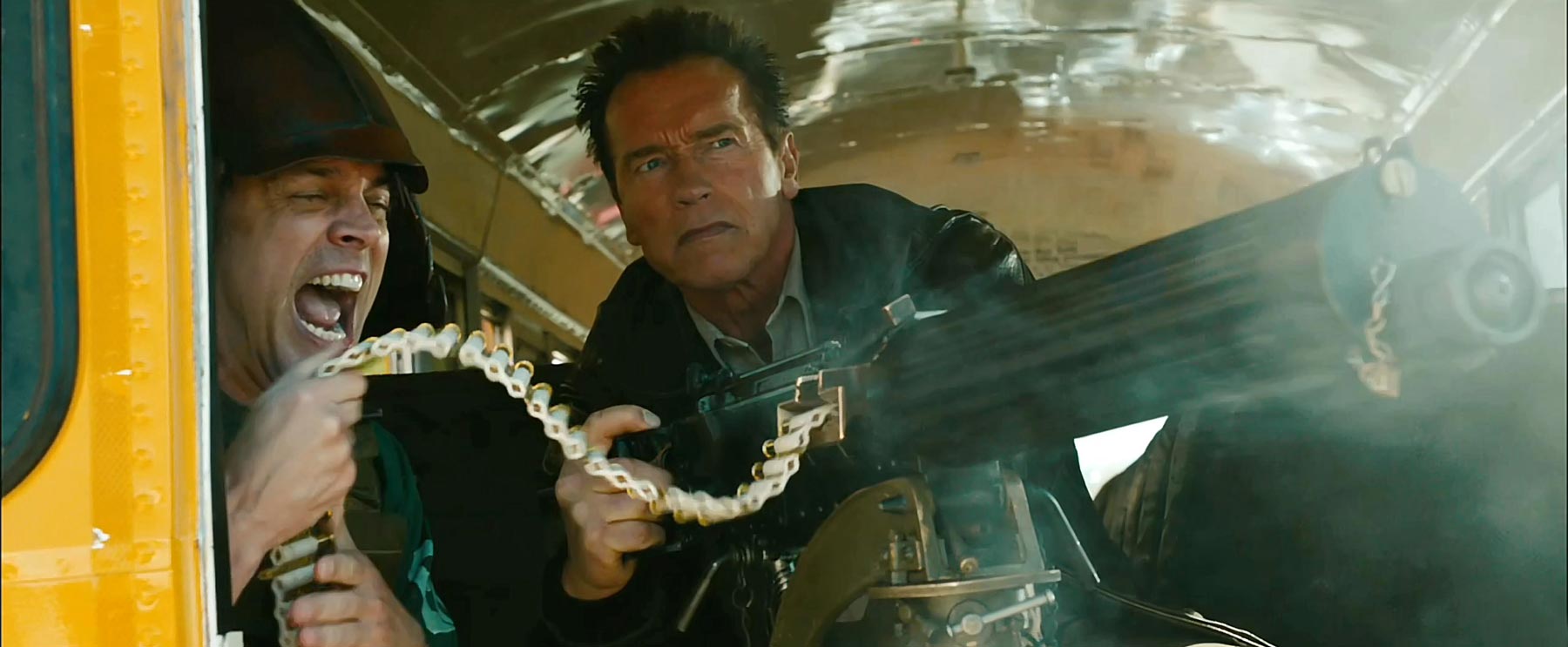
Its light praise to say a film is good for what it is but one suited for the solo return of Arnold Schwarzenegger in The Last Stand. It has very much been marketed as Schwarzenegger’s movie but for cineastes The Last Stand marked one of South Korea’s finest talents making his mark on American soil. Yes, for what it is (a big, dumb Schwarzenegger vehicle) its good fun but for what it could have been (Kim Jee-woon following on from Korean masterpieces, A Bittersweet Life and I Saw the Devil, it cripplingly under delivers on showing America how to do action.

'Why am I in a film with him?' ponders Arnie. 

The Last Stand is a stylishly mounted film but lacks the sizzling insanity of Jee-woon’s last action-western, The Good, The Bad and The Weird, and settles for something more generic. Largely the film skips along at a good trot but any personality and creativity saps from the screen when attention is given to wildly irrelevant sub-plots and characters. There are flares of inventive bloodletting and vaguely amusing one-liners and sight gags but nothing to rival “Let off some steam, Bennett” (Commando), “Hasta la vista, baby” (T2), “Consider that a divorce” (Total Recall)… The list really does go on.

The problem at the core of The Last Stand is that it does feel like the director has compromised for a mainstream western audience. There are good set pieces in the film, a visceral mano-a-mano showdown reassures that the Governor can still trade blows with the best of them, however it feels as though the great content in the film is somewhat obscured by the bland and generic. This is directly mirrored by the climactic car chase taking place in a corn field, stripping away any sense of scale or appreciation for the choreography. Take it for what it really is; a run-of-the-mill, meat and veg shoot-em-up that just happens to star old man Schwarzenegger and you will be pleasantly entertained. Go in expecting what it could and should have been and you’ll leave vastly unfulfilled.

The Films of 2012


Film of the year - The Turin Horse

A pretty much faultless film, Bela Tarr’s ninth and, he assures, last film is a nihilistic breakdown of religion and humanity. A difficult film to watch, a difficult film to enjoy and an even harder film to write about The Turin Horse is stunningly shot, hauntingly scored, bleak and ultimately apocalyptic. It is pure cinematic wonder.

The other 11

Beasts of the Southern Wild

The most wildly emotionally engulfing experience in cinema of the year, Benh Zeitlin’s first feature is an interesting counterpoint to The Turin Horse. Coming down on the other side of the life and death fable it’s a tale of facing death in a setting that’s both fantastically timeless and politically relevant. 

Lawless

The most violently underrated film of the year, John Hillcoat and Nick Cave’s follow up to Aussie-Western masterpiece The Proposition is an amazing piece of visceral filmmaking. Cave’s script is lyrically written yet earthy, witty and grounded and his soundtrack with Warren Ellis is, as always, superb. Lawless also delivered the greatest surprise in film this year sporting the best performance of the year in the shape of Shia LaBeouf. Who would’ve thought that? 
   
Searching for Sugarman

Knowing nothing of the artist, Rodriguez, I was enamoured by the best mystery tale I had seen in a film in years. And, with a pinch of salt, it’s real. The key to Searching for Sugarman’s success is the very simple, it’s just a really well told story and what a ripping yarn it is. The supposed liberties the filmmakers take with the story are totally irrelevant because they add so much to the perception of the film and the journey it takes you on. Searching for Sugarman is the most inventive and riveting documentary in years and snatches the top spot from Into the Abyss as documentary of the year.     

Once Upon a Time in Anatolia

It is both the most formulaic and laid out police procedural and the most wildly inventive and progressive. The most cathartic film in years, when Ceylan want you to be calm, frustrated, reflective, bored even, you are. And that's really not a bad thing. Really. Show cases the beauty of cinema and how it is a wonderful art of manipulation. Ceylan cements himself as the leading creative coming out of the flourishing Turkish film scene.

Into the Abyss

Not just Herzog’s best documentary since My Best Friend back in 1999 but also his best film in years, Into the Abyss is a genuinely illuminating and moving observation on the value of life. The purest and most balanced documentary since Marc Singer's Dark Days

Cosmopolis

Cosmopolis was a surprise for me personally. It was a film that, after the disappointment of A Dangerous Method, I was quite wary of. Cronenberg being one of my very favourite directors, I held out hope, mainly to the credit of a belting trailer but as its release drew nearer people I trust and respect started hinting that maybe it wasn’t so good. Due to the films limited release in London I didn’t manage to catch it in the cinema and only ended up watching it recently and thankfully loved it. It’s just such a measured, composed film. It pulses with a detached, voyeuristic energy. Cosmopolis is Cronenberg’s most conceptual film since Crash and when the concept is as reflective, topical, bizarre and divisive as this, it is compulsive, important viewing. 
 
Excision

The most brain-bustlingly bizarre film of the year, Excision also manages to be one of the most original and best. Carried by AnnaLynne McCord’s extraordinary, out of character performance the film recalls the works of John Hughes spliced with Georges Franju’s Eyes Without a Face and a dash of John Walters. A dizzying, disturbing and perversely erotic descent into teenage insanity and very much the best horror film since last year’s sublime The Woman.

The Hobbit

Yes, I’m biased. The Lord of the Rings were the films of my formative years and still some of my very favourite and I do think some of the very best. However, trying to strip away my bias on repeat viewings I still think The Hobbit is a cinematic marvel. It’s a lush, delightful epic that crams its overlong running time with so much content and wonder that any criticism that the book was being drawn out over three films are entirely unfair and just wrong. Each Lord of the Rings book corresponded to one film but we must also note that at least a third of each book was left out of the films to keep the trilogy from being five or six films. Forget the cynics, forget the inevitable backlash, The Hobbit is a soaring spectacle that is simply a pure joy to watch and with humble Martin Freeman delivering one of the finest performances of the year, it really is the year of the unexpecteds.

Killer Joe

It isn’t as lean and intense as Bug, Friedkin’s previous descent into Letts’ claustrophobic creations, but it has a manic, perpetual state of unrest and a film of such tight craftsmanship that is hard not to admire. I do admire the film very much and I enjoyed the film very much also. The film shocked me and took me aback but with atmosphere, with ingenuity and with violent lunacy, not with grim torture and pain free from irony. And that in this age of cinema is a success.

The Dark Knight Rises

Batman Begins remains the crown jewel of the trilogy and a veritable benchmark in cinema but as a trilogy, as a vision, Christopher Nolan has created something of such exhilarating scope and intelligence the likes of which is virtually unheard of. The Dark Knight Rises concludes a towering cinematic achievement. 

About Elly

From the director of A Separation, Asghar Farhadi, comes a stunningly crafted social drama with disconcerting and elusive roots in mystery and thriller cinema recalling The Vanishing. Perfectly composed and played by everyone in the cast, About Elly cements Asghar Farhadi as the leading talent emanating from the fruitful landscape of modern Iranian cinema.

Runners up (because 12 was never going to be enough)

The Hunt
Nostalgia for the Light
American Mary
The Raid
The Imposter