Saturday, 12 September 2015

Death Sentence Retrospective

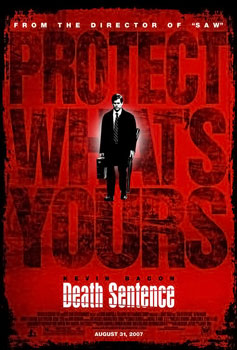
James Wan’s follow up to his breakout, Saw, comfortably wears the generic trappings of the neo-fascist revenge fantasy, à la Death Wish (of which Death Sentence incidentally shares a title with its literary sequel). You know the score, Kevin Bacon’s Nick Hume has a snazzy job and he lives in a big house with his great family (we know they’re great because we see home video footage of them) until one day his son is killed with a machete. Why do bad thinks happen to great people? A bit of crying on the floor/in the shower/back on the floor later and Bacon is ready to shoot some street punks with guns. It’s not a great film.
But - and it’s a big, Nicki Minaj-esque, surgically enhanced ‘but’ - it has one of the greatest action set-pieces of the last decade. A mid-film foot chase through back alleys leads into a bravura one shot tracking sequence through a multi-story car park that culminates with a crunchy, money shot death. It’s such a dynamic, meticulous, thrilling sequence that it goes to show just how well Wan ‘gets’ the nuts and bolts mechanics of a thriller. Like Michael Mann or the crème of the Korean thriller scene the action is the drama and vice versa. Admittedly, it’s an incredibly showy sequence but boy does it pay off, casting the rest of the film in a blindingly favourable light.       

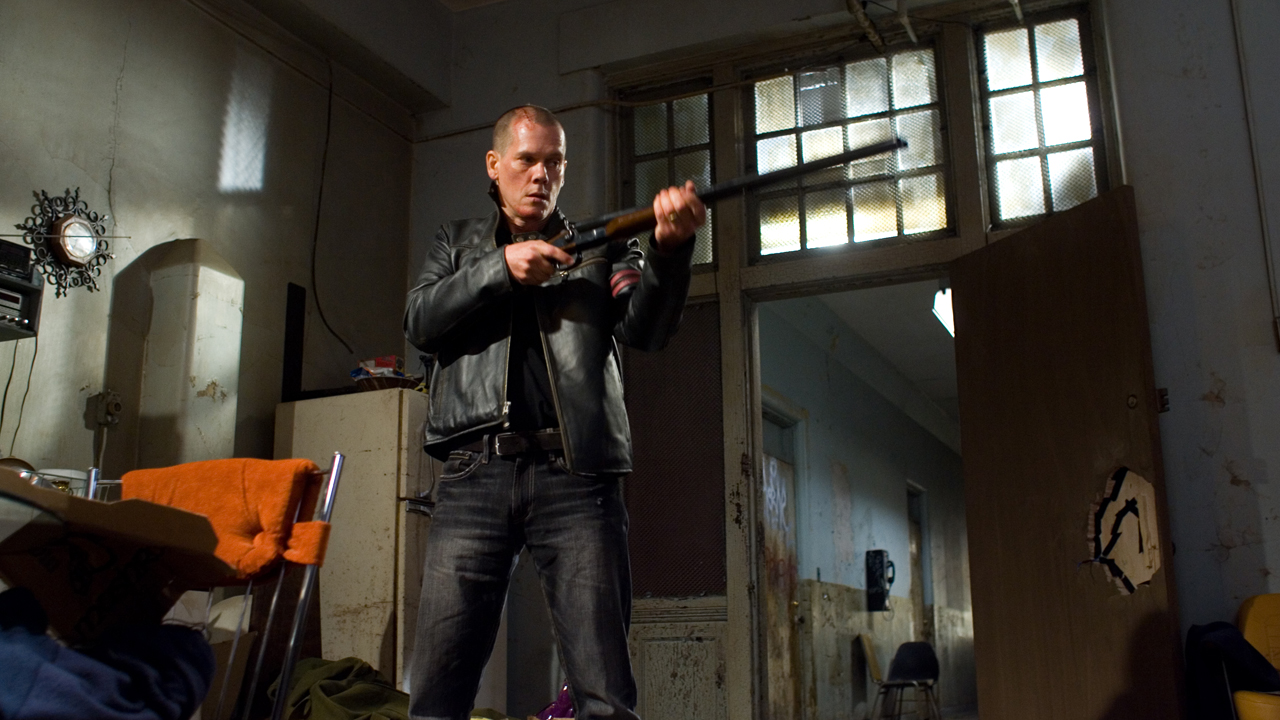
Amorous gushing aside, Bacon over-eggs and hams up his performance to the point of a convoluted food analogy. But back on track, Bacon does remind us that, when not gagging on the corporate paycheque pimping mobile providers, he really can hold the screen. When our man’s tooled up, shaven headed and shotgunning legs off with the best of them, you’re there with him.   

There is an air of Wan getting a bit big for his boots post the blow-up reception of Saw, lavishing the opening credits with the self-aggrandising ‘a James Wan film’ associated with the name-as-brad recognition of the Spielberg’s or the Nolan’s (you’ve made one film, James…). Also peppering the film with intertextual Saw references seems, well, masturbatory.         

By the end, Death Sentence does start to have notions above its station. The arch theme of nihilistic violence begets violence is heavy-handedly shoved in our face. Yeah, we’ve all seen The Last House on the Left, bet that was super fresh back in ’72 (or when Nietzsche penned that in the 19th Century for the book learned ones of you). But then it farts away any pathos with something of a cheap, redemptive ending. Like I said it’s not a great film but in all sincerity, for that scene alone, it’s worth the price of admission*.


*My price of admission was 80p     

Tuesday, 17 February 2015

Deus Ex Garland - Ex Machina Review


There is a moment in Ex Machina where Oscar Isaac’s Nathan sidles into an impromptu choreographed dance routine with another bit player of the piece. It's a hilarious, captivating and joyfully anachronistic scene that’s emblematic of Alex Garland’s directorial debut. It’s so self-assured you’d have no problem believing it’s the work of a time-tested auteur kicking back and showing the kids how it’s done. It's also showcases Garland’s pallete for artifice, for faking and manipulation (and all this to Get Down Saturday Night no less).  

"I though the blue pill would be smaller"

Conceptually, from the outset at least, we’re covering well-trodden ground. The android with consciousness is nothing new, from Blade Runner to A.I. to Her more recently, providing reflective discussion on the fabric of humanity, but Garland finds ways to make it as fresh as if you were looking at it with virgin eyes. The film opens with Domhnall Gleeson’s programmer, Caleb, winning a competition to spend a week with the reclusive Nathan (Isaac), pioneering CEO of the search engine Caleb works for. Nathan is no fey, Mark Zuckerberg-like wunderkind; he’s a full-blooded, full-bearded Colonel Kurtz of the technological world. A recluse in his ambiguously Nordic mountain-bound home, Nathan is building something, something he says will be the greatest achievement in the history of man (or is it the history of Gods…), a conscious A.I. Where Blade Runner presented the search for the machine in the human, Garland flips this dynamic on its head. Instead, Caleb is tasked with finding the human in the machine. The machine, Ava is her name, is the film's thesis embodied in a luminous and supple shell; the literal objectification of women, a man-manufactured prize in a glass showcase. Alicia Vikander has been great in the frocks of A Royal Affair and Anna Karenina but here is revealing and magnetic in the role of Ava delivering a testament to what it is to be human; the good, the bad, the dark truths. On many levels it is an unencumbered admission of man’s weakness and susceptibility to emotional and sexual manipulation.   

New extents of putting on her face

What’s most startling about Ex Machina is how Garland, ostensibly a screenwriter and novelist, flourishes in the director’s chair; it’s a composed and disciplined film. He displays a visual sensibility and conciseness of vision, on his first turn no less, to match any time-appointed auteur working today. The film looks incredible, sparing and aptly clinical thanks to Rob Hardy (the reason Blitz is the best looking Statham film) and sets the stage for the ever-shifting and escalating interplay between the three leads. As stated, it’s not much of a surprise that Garland’s script is razor sharp; dark, cerebral, acerbic but still human. It’s very much a three-man/machine piece with Isaac and Gleeson only further cementing themselves as two of the finest working today (boding very well for their joint future in the Star Wars behemoth) but most of all it’s proper Sci-Fi. Like Garland’s previous work on Sunshine and Jonathan Glazer’s Under the Skin last year, it’s a film about ideas, ideas of theology, morality, technology and humanity. In one fell swoop Garland has marked himself out as one of the most utterly exciting filmmakers working today and even among his pitch-perfect cast he really is the star of the show.       

Sunday, 16 February 2014

12 Years a Slave Review - 134 Minutes of Great

Steve McQueen’s third and best feature is the first film to tackle the American slave trade with the objective integrity required of the subject. 12 Years a Slave chronicles the titled dozen years of Solomon Northup from his kidnapping to enslavement to the end of his excruciating odyssey.   

To the marketers, 12 Years is an ‘important’ period piece but McQueen channels pure horror in its most reachable guise. The deep drones that permeate the boat ride down south for the fresh slaves makes the scene something approaching a hellish traversal of the river Styx. The specter of Southern Gothic courses through 12 Years’ veins. It’s all the more frightening that what’s being served up is so recent.
Once a free man


Every facet of character and context is so well noted volumes can be said in a few lines or actions. Take when Solomon defends Benedict Cumberbatch’s Ford to Eliza, saying him to be a good man in the context. She simply, perfectly retorts “in the context he’s a slaver”. Cumberbatch is dealt the most difficult performance and executes it faultlessly on a razor’s edge. Ford is what comes frighteningly close to a sympathetic character. In this he’s far worse than Michael Fassbender’s psychopathic Epps; it men like Ford who fuel the system, keep the cogs turning. 

It almost goes without saying but the cast is uniformly superb. Much attention has been drawn to Lupita Nyong'o in the role of Patsy and rightly so, she’s an outstanding discovery. Her conviction as an actress leads to multiple scenes which verge on unbearable to witness. Also, after years of being great in bit parts, Chiwetel Ejiofor carries the entire film and delivers a performance unrivaled in recent memory.


McQueen’s film only further puts into context the fervor surrounding Quentin Tarantino’s self-aggrandizing nonsense when talking of his own film ‘dealing’ with the slave trade, Django Unchained. Tarantino’s was a film of alarming vapidity; it wasn't about anything. This is a film of slavery first hand and as bare-boned and authentic an account as you’re ever likely to see. McQueen’s greatest trick is in his application of subject to accessibility. That’s not to say that it’s an easy film or a pared down one, quite the opposite but art house roots and trappings aside, it’s ostensibly the slave trade for the mass market. It’s historical and national shame wrapped up in a digestible fashion, albeit digestion that’s likely to leave violent nausea.


There is one sizable faux pas in the form of Bass (Brad Pitt); a savior-like figure that sails in as the voice of reason in the tail end of the film. Though assured to be a real figure in Northup’s account, within the context of the film he is a clunky inclusion to an otherwise faultless script. We don’t need to be told how bad slavery is and the shame it will cause in years to come, we've just witnessed it for two hours. This is the one moment when the film’s startling objectivity veers into more preachy territory.

McQueen has delivered the front runner for film of the year in the first quarter and in any films surpass 12 Years then we’re in for a stormer of a year. It needs to be made clear 12 Years a Slave is not a relevant film. Far from it. It is a shame this film has taken so long to emerge.

A harsh reality

Tuesday, 17 September 2013

Bangkok Dangerous - Only God Forgives Review


Only God Forgives sees Nicolas Winding Refn reuniting with his Drive muse, Ryan Gosling, to deliver what may well be his bravest film yet. After the relative breakout of Drive with a mainstream audience, Refn reverts back to earlier, darker and wholly less accessible avenues of his career.

Julian (Ryan Gosling) and his brother, Billy (Tom Burke), head up a Bangkok drug ring fronting as a Muay Thai club. Bangkok serves as Julian’s personal purgatory governed by violence and vengeance. Billy’s murder throws Julian into the ring (quite literally later in the film) with the old testament-channelling angel of vengeance, Chang. A policeman of sorts, Chang is the titular God of Only God Forgives: all knowing, untouchable, and without mercy.

Julien feeling a bit blue

Julian’s mother, Crystal (Kirstin Scott Thomas) is the Lady Macbeth of the piece; domineering, corrosive to everything she touches, a veritable demon clad in leopard print and peroxide blond. Scott Thomas delivers a magnetic, horrifying performance, the only person that reveals any humanity in the elusive and stoic Julian. Subtly and not so subtly we uncover a dark, Oedipal past that seems to hang behind his vacant, glacial eyes (Freud would have had a field day). He is a man haunted by his past, by his mother, by the death of his brother, by Chang.  But, most of all, he is a man haunted by violence.

A cinematographers wet dream

Only God Forgives is, like Drive and most Refn works, a film about violence. However, in the same way as A History of Violence and Taxi Driver, Drive explored the inherent violence in a man and to a greater extent the violence imbedded in American culture. Only God Forgives on the other hand is a film about violence as a physical and emotional imperative, the sole solution to any issue. This is where the recurring motif of hands comes into play; bunched in fists, being cut off, covered in blood… it is a film laden with such imagery. In a world governed by violence a man’s hands are his tools for violence, his only way of impacting the world he’s trapped in.  The idea of a man’s hands being removed renders him impotent. It’s Chang’s greatest punishment.

Refn wears his influence on his sleeve but this is where he differentiates himself from the superficially comparable Tarantino. Tarantino mimics, lifts and steals from what he loves to boast his eclectic knowledge whereas Refn’s surpasses homage, his films are knowing love letters that are never arch or exclusive. His films relate to other directors as much as they relate to genre, Fear X to Lynch, Bronson to Kubrick, Valhalla Rising to Tarkovsky. With Only God Forgives, Refn recalls his earlier Fear X, due in large part to their shared feverish, blood soaked cinematography, orchestrated by Larry Smith. However, the two films relation is more than skin deep. They are both films that explore what goes on around the confines of narrative rather than serve it up on a platter. Both films are not easily palatable but inaccessibility and depth together are often disregarded as pretension, a criticism far too easily laid at Only God Forgives. Every frame has a reason and an insight displaying a perfect exercise in intent and formality. Without over-lauding it, it does exactly what art should; it dispels with pretension and instead promotes interpretation.

It goes without saying but it’s not a film for everyone, it’s something of an obnoxious work that will anger, irritate and enthral in equal measure. This is something Refn revels in; provocation, he’s a director that wants to coax a response above garnering acclaim. In less capable hands this could come across as widely self-indulgent and to a degree it is. Watching Only God Forgives, it is wholly apparent that it’s a film untarnished by committee, a film made on the director’s terms.

Only God Forgives is a masterstroke in restraint and self-belief and only further cements Nicolas Winding Refn as the most uncompromising and exciting auteur of the last twenty years. It’s an incredibly rich film that rewards repeat viewings and even taking or leaving the wealthy subtext it’s just a startling sensory experience.


Wednesday, 10 April 2013

Spring Breakers review - A break beyond mending


Harmony Korine, who cut his teeth on the very independently spirited likes of Kids and Gummo, returns with the Disney-defiling Spring Breakers. It’s the tale of four young women who decide to cut loose on spring break and take the depraved holiday to new extremes. To set out ones stand early on, Spring Breakers is a turgid mess of a film. On a base level the film is a dirty slate of glaring errors. Korine’s script is an utter shambles only further crucified by dire delivery from the unredemptive female leads. Spring Breakers' lens is that of a pervert making the film a leering exercise in salaciousness that reduces any viewer of decent sensibilities to feeling foul and sullied.

How could that not be a good film?
For a film so throbbing with musical beats, neon colouring and near all that’s considered morally depraved under the sun, it’s criminally boring. Coming in at just over an hour and a half it feels drawn out to well over two thanks to flights of existential fancy in which one of the four hateable youths will repeat the same portentous, badly written lines over and over indefinitely. Korine’s attempt at pastiche is so poorly executed it only further exemplifies the ludicrous pretentions of his venture. There is one singular merit in Spring Breakers and it comes in the form of an utterly brilliant James Franco. Working miracles with the abhorrent script his slimy, cornrowed and grilled gangster rapper, Alien, is a wonderfully vile piece of characterisation but he never transcends being just a great character. His role in the film, like everything else, is ultimately unsubstantial and does nothing to save Spring Breakers from being the burning heap of a misguided project that it is.      

Spring Breakers worst mistake is to believe it’s holding a mirror up to the likes of modern chauvinist trash such as Project X or The Hangover films whereas it is in fact holding up a frame. A frame, which through we see the same trite, misogynist filmmaking that we’ve come to hate and condemn. Pervy, ignorant, filmmaking is one thing. Pretentious pervy, ignorant filmmaking is something else entirely and something even harder to stomach.

Maniac review - Like Brainiac, only with more Scalping


Maniac is a stylish and intelligent re-appropriation to William Lustig’s nasty 1980 slasher film of the same name but that’s not to say it’s a film that works on all fronts. Being shot nearly entirely from the first person view point of Frank, (well played by Elijah Wood for someone hardly visible in the film) Maniac plants us inside the deranged mind of a scalp-hungry killer. We are given front row seats to Frank’s theatre of sadistic expression as he roams the Taxi Driver-inflected streets of a shimmering New York City. Maniac draws as much from the gleaming as from scuzzy recalling Nic Winding Refn’s Drive. The comparisons to Refn’s film are only skin deep however. Drive knew perfectly how to reference and how to innovate, Maniac’s slides into intertextual homage feel wildly out of place with how nasty and witless it is.

maniac08.jpg
A scalpin' good time
Frank's obsession with the still, corpse like mannequins explicitly dictates an underlying necrophilic fascination. This theme of the film isn't dealt with reflectively but exploitatively and becomes a weight pressing down on the audience, a heavy burden of morbid, sexualised and unprecedentedly explicit content. Later in the film we are given reason to question what of Franks imposed reality is actuality and what is his wavering vision of the world. This is when the film is at its strongest, playing on the given perspective to subvert the preconceived expectations of the audience. This is when Maniac is at it’s most filmic and enjoyable, playing with our expectations in a way only cinema can accomplish.

 Maniac doesn't quite hit its mark but it certainly hits hard containing scenes even the most hardened horror fan will squirm at. To watch Maniac is quite an undertaking as the given viewpoint of the violence can only appear voyeuristic and leering. Cinema is, in itself, a voyeuristic, leering experience but through narrative and filmmaking tricks we are manipulated to forget that and be immersed in what we’re watching. While watching Maniac, you are constantly aware that you are seeing through the eyes of someone who finds a fetishistic allure to horrifically deforming women and that is, depending on ones own sensibilities, a draining experience. Maniac is a well crafted, challenging film and one not hard to admire but one hard to like and a film that ultimately leaves you feeling defeated. 

maniacheader9999817.png